
Official distributor for: XIOM table tennis blades, rubbers TSP table tennis blades, rubbers JOOLA table tennis blades, rubbers CHAMPION table tennis blades, rubbers Butterfly table tennis blades, rubbers
table tennis store login
Login
ping pong store
ping pong store

Language:
Currency:
VAT Mode:
 
Previous  Up  Next" 
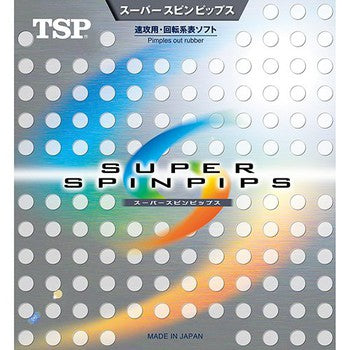
TSP Super Spinpips - Short Pips Table Tennis Rubber

TSP Super Spinpips - Short Pips Table Tennis Rubber


E-mail this product to a friend E-mail this product to a friend

Performance Rating

Speed Rating
You have not installed Adobe Flash. You can see the chart only then.
Spin Rating
You have not installed Adobe Flash. You can see the chart only then.
Hardness
You have not installed Adobe Flash. You can see the chart only then.
DMCA Notice: None of the information (images, graph, product details, categories) on this site to be copied to reuse on websites, blogs, forums or for commercial sales.

Product Information

TSP Super Spinpips is a flexible rubber & Great improvements have been made in the shape of the pips. This soft rubber has great stability with excellent rotation.

Super Spinpips is the new re-designed Spinpips. Super Spinpips retrains all of the playing characteristics of the orginal Spinpips. Super Spinpips has excellent speed and a deceptive knuckle-effect. This is the combination of effects for which Spinpips has become so well known at International events since 1988. Super spinpips 21 sponge has a unique top-sheet and the elastic sponge. This combination produces more powerful top-spin shots than the original spin-pips and md-spin pips.

TSP Super Spinpips is a newly designed pimple out rubber. It has retained all the essential playing characteristics of the original Spinpips rubbers. It provides excellent speed and an amazing long pimple effect. The interplay of these attributions has made Spinpips so popular at international events. Super Spinpips has a unique top sheet and an elastic sponge. This combination produces a powerful top-spin and a fine balance of speed and control. Super Spinpips has effectively more speed and control than the original Spinpips.

Add to Cart and Place order

Price: $40.99 
Has someone offered you a lower price? Let us know. We can help!
Specifications: <specification> <speed> <lowerLimit>0</lowerLimit> <upperLimit>20</upperLimit> <low>5</low> <medium>10</medium> <fast>15</fast> <extreme>20</extreme> <dial>9</dial> </speed> <spin> <lowerLimit>0</lowerLimit> <upperLimit>14</upperLimit> <low>3</low> <medium>6</medium> <high>10</high> <extrahigh>14</extrahigh> <dial>8.25</dial> </spin> <hardness> <lowerLimit>0</lowerLimit> <upperLimit>10</upperLimit> <low>0</low> <medium>5</medium> <high>10</high> <dial>5</dial> </hardness> </specification>


Stock Data 2.2mm 1.9~2.1mm 1.4~1.7mm 1.0~1.3mm
Red Yes Yes Yes Yes
Black Yes Yes No Yes
Quantity:  
TSP Super Spinpips - Short Pips-out Table Tennis Rubber


Show Picture 1Show Picture 2Show Picture 3Show Picture 4Show Picture 5

TSP Super Spinpips - Short Pips-out Table Tennis Rubber

TSP Spectol Soft Speed Sponge - Short Pips-ou Table Tennis Rubber
TSP Spectol Soft Speed Sponge - Short Pips Table Tennis Rubber

TSP’s Spectol Pips Out rubber has been considered by many to be the finest pips out rubber in the world for many years. Many of the top world players including World ,Olympic, European & Asian Champions have used Spectol. Spectol offers the user a resistance to the opponents spins.It also offers  excellent speed and the ability to produce shots that have a slight knuckle-ball effect that opponents can find tricky to follow.

TSP Spectol pips-out gives you great control over your opponents spin. Spectol produces a unique kind of spin of its own that can be troublesome to your opponents. Spectol also produces excellent speed and greatly enhances the backhand side of shakehand players.

Spectol is now available with 21 series sponge for enhanced performance with the 40mm ball.

In stock

TSP Spectol 21 Offensive Sponge - Short Pips-out Table Tennis Rubber
TSP Spectol 21 Offensive Sponge - Short Pips Table Tennis Rubber
Rubber has high stability and is good for speedy smashes and sending knuckle balls.  Used by Li Jia Wei of singapore.

The TSP Spectol 21 with hardness of 3 and the orange sponge is to play 40 mm balls. It enhances all of the playing characteristics of Spectol pips-out rubber. This new combination produces a unique kind of spin of its own that can be troublesome for your opponents. This combination can be powerful weapon when used on the backhand side of a shakehand racket.

No speed glue is necessary to generate spin and speed. Put on a TSP Hino-Power or TSP Hino-Speed blade - the domination starts there.

TSP Spectol 21, TSP has managed to give this elastic pimple out rubber more speed with the same control. Suitable for direct attacking at the table.
In stock

TSP Spectol Soft - Short Pips-out Table Tennis Rubber
TSP Spectol Soft - Short Pips Table Tennis Rubber

TSP’s Spectol Pips Out rubber has been considered by many to be the finest pips out rubber in the world for many years. Many of the top world players including World ,Olympic, European & Asian Champions have used Spectol. Spectol offers the user a resistance to the opponents spins.It also offers  excellent speed and the ability to produce shots that have a slight knuckle-ball effect that opponents can find tricky to follow.

TSP Spectol pips-out gives you great control over your opponents spin. Spectol produces a unique kind of spin of its own that can be troublesome to your opponents. Spectol also produces excellent speed and greatly enhances the backhand side of shakehand players.

Spectol is now available with 21 series sponge for enhanced performance with the 40mm ball.

TSP Spectol, a pimple out rubber, ideal for direct counter attacking tactics close to the table.

In stock

Epox Powercarbon
Donic Epox Powercarbon
The Donic Epox Powercarbon blade has a soft carbon fibre layer between a Fineline outer veneer and an Ayous middle veneer. This makes it even more dynamic and stiffer when compared to the Epox Carbotec. A high speed and aggressive blade of excellent design and outstanding quality.
In stock

Waldner Senso Carbon V1
Donic Waldner Senso Carbon V1
Perfect blade for attackers as well as aggressive allround players. This model is based on the famous DONIC Allplay that is one of the best-sellers in the world. Two additional Carbon layers combines the unique characteristics of the high-tec component Carbon with the time-proven Swedish allround construction. The result is fantastic speed and control in an ideal balance. Includes the Senso V1 hollow handle technology. An elastic component of this blade gives you the essential feedback of the bounce of the ball.
In stock

TSP CH-5 Chinese Style Penhold - ALL Table Tennis Blade

The TSP CH-5 is an extremely easy to use all-round Chinese Penhold blade with great balance.

75 +- 5 g 155 mm 153 mm 7 mm 85 mm
In stock

TSP Hino-Carbon Power Chinese Style Penhold - OFF Table Tennis Blade

The TSP Hino-Carbon Power is made of Cypress, Indus, Juniper wood withcarbon fiber makes this an attacking blade. Very suitable for close tothe table hit and drive game. It has very soft feel.

The TSP Hino-Carbon Power generates speed and spin that the players have gained in the speed glue era.

Singapore's Li Jia Wei uses TSP Hino-Carbon Power.

85 +- 5 g 160 mm 150 mm 7 mm 82 mm
In stock

TSP Reflex 50 Award Offensive Chinese Style Penhold - OFF Table Tennis Blade
TSP Reflex 50 Award Offensive Chinese Style Penhold

The TSP Reflex 50 Award Offensive has western Hiroshi hard wood and combination of high resistance black material. Great for close to the table smashing and shot game.

This blade is made of a special construction that utilizes a lamination of specialized rubber between the blade and the grip. This creates an amazing flexibility and allows a very large sweet spot with excellent spin, speed and control.

The TSP Reflex series of blades are best sellers in Europe and Asia. The players trust its consistent performance.


80 +- 5 g
154mm 151mm 6mm 84mm
In stock

TSP Super Spinpips 21 Offensive Sponge - Short Pips-out Table Tennis Rubber
TSP Super Spinpips 21 Offensive Sponge - Short Pips Ping Pong Rubber

TSP Super Spinpips 21 is for both power and control. A very soft and flexible rubber with great rotation.

Super Spinpips is the new re-designed Spinpips. Super Spinpips retrains all of the playing characteristics of the orginal Spinpips. Super Spinpips has excellent speed and a deceptive knuckle-effect. This is the combination of effects for which Spinpips has become so well known at International events since 1988. Super spinpips 21 sponge has a unique top-sheet and the elastic 21-sponge. This combination produces more powerful top-spin shots than the original spin-pips and md spinpips.

TSP SuperSpinPips 21 TSP Super Spinpips-21 has the same unique top sheet as the Super Spinpips, but is combined with the more elastic TSP-21 offensive sponge.

In stock

TSP Tyranno Multi Power Sponge - Short Pips Ping Pong Rubber
TSP Tyranno Multi Power Sponge - Short Pips Table Tennis Rubber

Used by many top athletes for it's speed glue affect. Power Sponge combines with TSP Tyranno topsheet make it a very stable pips-out.

The multi-power elastic-type sponge creates maximum speed production. It has excellent speed and control of the 40 mm ball. The unique combination of power and stability makes a high degree of offensive play possible. TSP TYRANNO has the unique built-in power with its elastic type of pips.

TSP Tyranno TSP Tyranno is a new pimple-out rubber with built-in speed glue effect, which gives attacking shots optimal speed. In addition, Tyranno produces its own dynamic spin. The soft sponge together with the short pimples, supports the ball control in passive or defensive shots. Tyranno is therefore an attractive alternative for all different pimple-out strategists.

Use it TSP BalsaFiber 8.5 table tennis blade to have extreme speed and spin.

In stock
Performance Parameter Value

Table Tennis Rubbers effecting Spin and strokes

Table Tennis Spin

Backspin: The easy-to-learn backspin strokes adds subtle lift to the first part of the ball-curve, lets the ball drop more suddenly, makes the ball bounce more upright and most significantly: makes the ball dive downwards when the opponent uses a common rubber (pimples inwards) on his racket. (The opponent is forced to seriously compensate for the backspin) Due to the initial lift of the backspin-curve, there’s a limit on how much speed one can hit the ball without overflying the opponents half. Backspin also makes it harder for the opponent to hit the ball with lots of speed. In table-tennis backspin is regarded as a defensive alternative, due to: the limitation on ballspeed, the simplicity of producing the strokes and the daring of the opponent. (It is possible to smash with backspin offensively, but only on easy high balls, close to the net)

Topspin: The hard-to-learn topspin strokes has a minor influence on the first part of the ball-curve, but the Magnus effect clearly forces the ball back down as it approaches the opposing side. On the bounce the topspin will accelerate the ball a little more. Again the most significant change appears when the opponent hits the ball (with a common pimples inwards rubber on his racket). Due to the topspin the ball jumps upwards and the opponent is forced to seriously compensate for the topspin. There’s virtually no limit on how much speed a topspin-ball can be given (besides your own timing and strength) and a speedy topspin stroke gives the opponent very little time to respond. In tabletennis topspin is regarded as a offensive alternative, due to: the virtual limitless ballspeeds, the highly required skills for producing the strokes and the enhanced tactical pressure on the opponent. (It is possible to play defensive topspin-lobs from far behind the table, but only world class players use this type of gallery play successfully)

Offensive strokes

Speed drive

These strokes differ to ones from other racket sports like tennis. The racket is primarily perpendicular to the direction of the stroke, and most of the energy applied to the ball results in speed rather than spin, creating a shot that does not arc much, but is fast enough that it can be difficult to return. A speed drive is used mostly for keeping the ball in play, applying pressure on the opponent and potentially opening up an opportunity for a more powerful attack. Loop drive

Essentially the reverse of the speed drive. The racket is much more parallel to the direction of the stroke ("closed") and the racket thus grazes the ball, resulting in a large amount of topspin. A good loop drive will arc quite a bit, and once striking the opponent's side of the table will jump forward, much like a kick serve in tennis. Returning a loop drive may not be as difficult to return as a speed drive; however, because of its topspin, it is more likely to rebound off the opponent's racket at a very high angle, setting up an easy smash (described below) on the follow up. As the loop drive requires a lot of topspin, players generally use their entire body to generate the movement required. Variations in spin and speed add to the effectiveness of this shot.

Chinese players categorize loop-drives in 3 variations based on trajectories:

1. The "Loop"

The "Loop" produces a more pronounced loopy arc, with a higher trajectory and extreme topspin, but is typically slower.

2. The "Loop Kill" ("Rush" in China)

The "Loop Kill" produces a flatter arc, with higher speed that resembles a speed drive but with stronger topspin, typically used for replacing speed drive or smash in "put-away" situations.

3. The "Hook"

Similar to a regular Loop, but carries a tilted topspin (or is referred as the "top-side" spin), it bounces sideways and downward upon hitting the table. Similar to but stronger than the defensive "side-drive" described below.

Counter drive

Usually a counter attack against drives (normally high loop drives). You have to close the racket and stay close to the ball (try to predict its path). The racket is held closed and near to the ball, which is hit with a short movement "off the bounce" (before reaching the highest point) so that the ball travels faster to the other side. If performed correctly, a well-timed, accurate counter-drive can be as effective as a smash. Flip (or Flick in Europe)

When a player tries to attack a ball that has not bounced beyond the edge of the table, he/she does not have the room to wind up in a backswing. The ball may still be attacked, however, and the resulting shot is called flip because the backswing is compressed into a quick wrist action. A flip is not a single stroke and can resemble either a drive or a loop in its characteristics. What identifies the stroke is instead whether the backswing is compressed into a short wrist flick. Also known as 払い "harai" in Japanese.

Smash

The offensive trump card in table tennis. A player will typically execute a smash when his or her opponent has returned a ball that bounces too high and/or too close to the net. Smashing is essentially self-explanatory—large backswing and rapid acceleration imparting as much speed on the ball as possible. The goal of a smash is to get the ball to move so quickly that the opponent simply cannot return it. Because the ball speed is the main aim of this shot, often the spin on the ball is something other than topspin. Sidespin can be used effectively with a smash to alter the ball's trajectory significantly, although most intermediate players will smash the ball with little or no spin. An offensive table-tennis player will think of a rally as a build-up to a winning smash; only a calculated series of smashes can guarantee a point against a good opponent. However, most players will be able to return at most one or two smashes consistently. Provided that the opponent is not too close to the table or too far away from the ball, a smash can be lobbed, chopped, blocked or even counter-looped, albeit with some difficulty. A player who smashes generally works out a series of smashes (and possibly drop-shots) to rush the opponent out of position, put him off balance, or both. Smashers who fail to do this find it difficult to win a point against an excellent defense.

Defensive strokes

Push (or Slice in Asia)

The push is usually used for keeping the point alive and creating offensive opportunities. A push resembles a tennis slice: the racket cuts underneath the ball, imparting backspin and causing the ball to float slowly to the other side of the table. While not obvious, a push can be difficult to attack because the backspin on the ball causes it to drop toward the table upon striking the opponent's racket. In order to attack a push, a player must usually loop the ball back over the net. Often, the best option for beginners is to simply push the ball back again, resulting in pushing rallies. For good players it may be the worst option because the opponent will counter with a loop, putting you in a defensive position from which most likely you will lose, unless you are a good chopper. Another option to pushing is to flip the ball when it is close to the net. Pushing can have advantages in some circumstances. Players should only push when their opponent makes easy mistakes. Offensive players should only push for variation and not for general rallies. A push can easily be counter-looped into the opposite corner if it is not short enough. The goal of most player's pushes is to make the ball land too short to be attacked, rather than attempting to over-spin the opponent.

Chop

A chop or cut is the defensive, backspin counterpart to the offensive loop drive. A chop is essentially a bigger, heavier slice, taken well back from the table. The racket face points primarily horizontally, perhaps a little bit upward, and the direction of the stroke is straight down. The object of a defensive chop is to match the topspin of the opponent's shot with your own backspin. A good chop will float nearly horizontally back to the table, in some cases having so much backspin that the ball actually rises. A chop such as this can be extremely difficult to return due to the enormous amount of backspin. Sometimes a defensive player can impart no spin on the ball during a chop, or frequently add right- or left-hand spin to the ball. This may further confuse his/her opponent. Chops are difficult to execute, but are devastating when completed properly because it takes a tremendous amount of topspin on a loop drive to return the ball back over the net.

Block

The block or short is a simple shot, barely worthy of being called a "stroke," but nonetheless can be devastating against an attacking opponent. A block is executed by simply putting the racket in front of the ball—the ball rebounds back toward the opponent with nearly as much energy as it came in with. This is not as easy as it sounds, because the ball's spin, speed, and location all influence the correct angle of a block. It is very possible for an opponent to execute a perfect loop, drive, or smash, only to have the blocked shot come back at him just as fast. Due to the power involved in offensive strokes, often an opponent simply cannot recover quickly enough, and will be unable to return his own shot blocked back to him/her. Blocks almost always produce the same spin as was received, which is nearly always topspin.

Push-Block

High level players may use what is called push block or active block, adding speed to the ball (with a small topspin movement). When playing in the Penhold Grip, many players use push blocks when being pressured on the backhand. Chinese pen-hold players refer to it as a push-block as they literally "push" their backhand forward, instead of simply blocking it.

Side Drive

This spin shot is alternately used as a defensive and offensive maneuver. The premise of this move is to put a spin on the ball either to the right or the left of the racket. The execution of this move is similar to a slice, but to the right or left instead of down. This spin will result in the ball curving to the side but bouncing in the opposite direction when the opponent returns it. Do not attempt a right-side spin (moving your arm to the right when hitting the ball) when too close to the left side of the table, and vice versa. To return, simply execute the same sided spin as your opponent just gave you.

Lob

The defensive High Ball or Lob is possibly the visually most impressive shot in the sport of table tennis, and it is deceptive in its simplicity. To execute a High Ball, a defensive player first backs off the table 4-6 meters; then, the stroke itself consists of simply lifting the ball to an enormous height before it falls back to the opponent's side of the table. A High Ball is inherently a creative shot, and can have nearly any kind of spin you can imagine. Top quality players use this fact to their advantage in order to control the spin of the ball. For instance, though the opponent may smash the ball hard and fast, a good defensive Lob could be more difficult to return due to the unpredictability (and heavy amounts) of the spin on the ball. Thus, though backed off the table by tens of feet and apparently running and leaping just to reach the ball, a good defensive player can still win the point using good High Balls. However, most of the time one will lose the point so it is not recommended unless it is really necessary.

Drop Shot

The drop shot is a high level stroke, used as another variation for close-to-table strokes (like harai and slice). You have to position the racket close to the ball and just let the ball touch it (without any hand movement) in a way that the ball stays close to the net with almost no speed and spin and touches the other side of the table more than twice if the opponent doesn't reach it. This stroke should be used when opponents are far from the table and not prepared to get close to the table. This technique is most usually done by pen-holders and players who use long or short pimples. A very deceiving technique, this could result in the opponent failing to reach the ball after misjudging the distance of the ball. A perfectly executed stroke after a topspin sequence can win a point.

- Wikipedia

Table Tennis Racket

A table tennis racket or paddle is used by players in the game table tennis. The racket is made from laminated wood covered with rubber on one or two sides depending on the grip of the player. This is called either a paddle, racket, blade or a bat depending on where in the world the game is being played. In the USA the term "paddle" is common, in Europe the term is "bat," and the official ITTF term is "racket." This section will use the ITTF term.

Table tennis regulations allow different surfaces on each side of the racket. The different types of surfaces provide various levels of spin or speed, or in some cases, nullify spin. For example, a player may have a rubber that provides much spin on one side of his racket, and no spin on the other side of the racket. By flipping the racket in play, different types of returns are possible. To help a player distinguish between different types of rubber used by his opposing player, international rules specify that one side must be red while the other side must be black. The player has the right to inspect his opponent's racket before a match to see the type of rubber used and what color it is. Despite high speed play and rapid exchanges, a player can see clearly what side of the racket was used to hit the ball. Current rules state that, unless damaged in play, the racket cannot be exchanged for another racket at any time during a match.

Recent years have seen an advancement in technology of table tennis blades. Materials of different properties may be combined with the wood in the blade to enhance its playing performance. Many blades today feature one or more carbon layers within them to enhance their 'sweet spot', and to give the player a greater margin of error when playing powerful shots. Materials incorporated into table tennis blades today include titanium, acrylate, aramids, fiberglass, and aluminium.

The rubber coating may be of pimpled rubber, with the pimples outward, or it may be a rubber that is composed of two materials, a sponge layer, covered by a pimpled rubber, with the pimples pointed inwards or outwards. Some rackets are not covered with rubber at all, because a "naked" racket is more resistant to a spin. However, it is illegal to use these types of racket in competition as they are not approved by the ITTF. Some types of rubbers are also not approved. Approved rubbers have the ITTF emblem on the base of the rubber.

Players have many choices and variations in rubber sheets on their racket. Although a racket may be purchased with rubber by the manufacturer, most serious tournament players will create a customized racket. A player selects a blank blade (i.e. a racket without rubber), based on his playing style. The type of wood and synthetic layers used to make up the blade will provide a slower or faster blade. The player can choose from different types of rubber sheets which will provide a certain level of spin, speed and specific playing characteristics.

Normally, a sheet of rubber is glued to a blade using rubber cement and not removed until the rubber wears out or becomes damaged. In the 1980s, a new technique was developed where the player would use a special glue called speed glue to apply the rubber every time he played. The glue would help provide more spin and speed by providing a "catapult" effect. This technique is known as "regluing" and has become a standard technique for top players.

The surface of a racket will develop a smooth glossy patina with use. The rubber surface needs to be regularly cleaned to ensure it retains a high friction surface to impart spin to the ball. Players use a commercial cleaner, or just water and detergent as cleaning agents.

Racket construction and new rubber technology (skilled elite players typically select and attach the rubber to their own rackets and glue them before every match) contribute significantly to the amount of deviation from the expected ball flight path. The fairly recent development of speed glue speeds up the departure of the ball from the rubber considerably, though at the cost of some ball control on touch shots where little or no spin is put on the ball. Speed glue was allowed for the last time in the 2008 Summer Olympics. From the 2012 Summer Olympics on speed glue will be banned at the Olympic games.

Different types of rubber sheets

1. Inverted (non-Chinese): This is the most widely used rubber type. The surface is smooth, with the pimpled side facing inwards toward the blade. This enables the player to generate high levels of spin and speed. Spin is generated not by the action of the topsheet alone, but also by the ball sinking into the sponge and allowing greater surface area to contact the ball.

2. Inverted (Chinese): Chinese rubbers typically have stickier (or "tackier") topsheets. Spin is generated mainly by the topsheet, as opposed to the sponge, which is more condensed and firm. The result is usually a far better short game and potential offensive capabilities than normal inverted, but also a less consistent defensive and/or counter play.

3. Short pimples (or "pips"): Short pimples-out rubbers are usually used by close-to-the-table hitters (for example, Liu Guoliang). They do not generate as much spin as inverted rubbers, but also make the user less susceptible to the opponent's spin. Speed generated from a short pip rubber is generally greater than that of an inverted with the same sponge. Depending on the thickness of the sponge it is also possible to play a chopping game with short pimples by varying the spin of the return. Whilst blocking and attacking a "dead ball" effect is often noticed. Ding Song is an exponent of this style.

4. Long pimples (or "pips"): Long pimples-out rubbers carry relatively long and soft pips. They do not have the ability to generate any real spin of their own, but feed off of the opponent's spin instead. This allows the user to confuse the opponent and upset his or her rhythm. Long pips rely on the opponent's oncoming spin, as they tend to "continue" the opponent's spin, by bending upon impact, rather than reversing or changing the spin like inverted rubbers (for example, a topspin executed by the opponent will return to him/her as a backspin after contact with the pimples). Long pips are usually used by close-to-the-table blockers, or choppers, but, in some cases, they can be used away from the table for long distance chops. They are usually only used on the backhand side, as they offer very limited attacking capabilities. Depending on the grip of the sides of the pimples and the thickness of the sponge it is also possible to play an aggressive game with long pips, although without much spin capability.

5. Anti-spin: Anti-spin rubbers may look similar to the inverted ones, but their surfaces are very slick and frictionless. Like long pimples, they cannot generate much spin. Anti-spin is also not very susceptible to the opponents oncoming spin, due to the low coefficient of friction of the rubber's surface, as well as the incredibly soft sponge, which is designed to cushion or absorb the momentum of the ball upon impact. This is also used to confuse the opponent, but is not widely used on a competitive level.


Sign up to receive discounts!
Email :